


Life Behind Bars: Tahir Hussain and Four Others Convicted for Brutal Killing of IB Officer Ankit Sharma in 2020 Delhi Riots
- Devansh Purohit
- Aug 1
- 3 min read

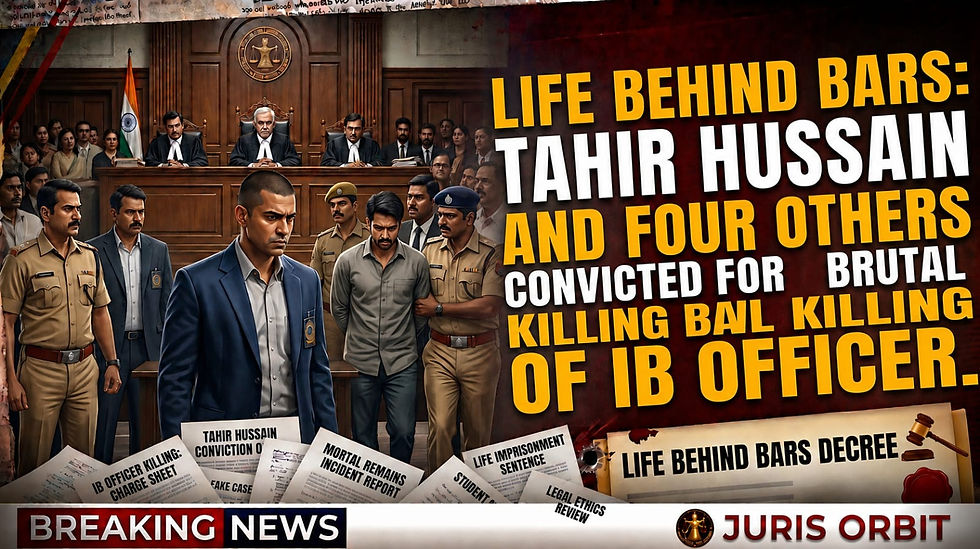
A Delhi court has sentenced former AAP councillor Tahir Hussain and four co-accused to life imprisonment for the 2020 murder of Intelligence Bureau staffer Ankit Sharma during the North-East Delhi riots. Judge Praveen Singh rejected the prosecution's demand for the death penalty, calling the killing brutal but not fitting the rarest-of-rare standard.
Read Full Report
More than five years after Intelligence Bureau staffer Ankit Sharma was killed during the 2020 North-East Delhi riots, a Karkardooma court has handed down its sentence, ordering life imprisonment for former Aam Aadmi Party councillor Tahir Hussain and four other men convicted in the case. Additional Sessions Judge Praveen Singh pronounced the sentence on Friday, bringing a long-running trial to its conclusion, though the matter is widely expected to head to the Delhi High Court.
The case goes back to February 25, 2020, when Sharma went missing amid the communal violence that swept through parts of North-East Delhi. His father, Ravinder Kumar, filed a complaint after his son failed to return home. Sharma's body was recovered from a drain the following day. A post-mortem examination found 51 injuries on his body, inflicted by both sharp and blunt weapons, and investigators later said he had been abducted, assaulted and killed by a mob before his body was dragged and dumped.
The Delhi Police's charge sheet described a coordinated and premeditated attack, naming Hussain as the man who allegedly instigated the mob from outside his own house, after which a group of twenty to twenty-five rioters, armed with stones, rods, and knives, reportedly caught hold of Sharma near Chand Bagh Pulia. Hussain was arrested from a Delhi court in early March 2020 and taken into custody; the Aam Aadmi Party suspended him from the party shortly after the allegations surfaced. He was convicted on July 13 this year, along with co-accused Javed, Anas, Nazim and Kasim, under section 302 of the Indian Penal Code for murder, alongside charges of rioting, rioting with a deadly weapon, promoting enmity between communities, and kidnapping.
During the sentencing hearing on July 27, the prosecution pressed for the death penalty, arguing that the convicts showed no remorse and that the sheer brutality of the attack, with the post-mortem showing several injuries that were independently fatal, met the threshold for the harshest punishment available under law. Defence counsel for Hussain, advocate Rajiv Mohan, countered that the death penalty cannot be a default outcome in every murder case and that both aggravating and mitigating factors needed to be weighed carefully.
In its final order, the court agreed that the manner of the killing was extremely brutal, with the judge noting that the violence did not end with Sharma's death since his body was further dragged into a drain nearby. Even so, the bench held that the case did not meet the rarest-of-rare threshold required for capital punishment, observing that the prosecution had not shown that the convicts had a prior violent history or were beyond any possibility of reform. The court also took note of the convicts' generally satisfactory conduct while in custody. Besides the life term, Hussain was fined five lakh rupees under the murder charge, with smaller fines imposed under the other sections, while his co-convicts were fined twenty-five thousand rupees each for murder along with separate amounts under the remaining charges.
The verdict was delivered amid tight security, with senior police officers including the Joint Commissioner of the Crime Branch present in court. Hussain, maintaining his innocence, told reporters he would seek justice in the High Court. Sharma's brother, Ankur Sharma, said the family had wanted the death penalty and would continue to pursue the harshest possible punishment as the case proceeds through the higher courts, adding that the family hoped an example would be set so that no other family suffers a similar loss.

Comments